
Last weekend for my birthday Susan planned a weekend getaway and rented a Tesla Model S for us to drive. I’ve been curious about what they’re like inside and how well their fully self-driving (FSD) system works. After two days and nearly 600 miles in one I can tell you that I have seen the future and someday everyone will either own one or something like it. Despite a few minor flaws (it totally tried to kill us at least twice), it’s a freaking wonder of technology.
Although Susan had reserved either a Tesla Model X or a Y (their compact and full-sized SUV models) we ended up with an S, their “luxury sedan”. The rental came with a short training session, not unlike the one we received when we rented an RV. Inside, a Tesla S is both like any other car and different from every other car. The Tesla S comes with a 17″ touchscreen mounted in the center of the dash — it’s hard to miss, and its presence is so shocking that it took us a minute to realize there’s not much else there. There are no blinker or windshield wiper levers on the steering wheel (er, yoke) and no knobs to manually adjust the air conditioning vents or side mirrors. There aren’t any handles on the glove box or the inside of the doors. There’s not even a gearshift. The car has an overwhelming feeling of “form over function,” but man is the form sleek.
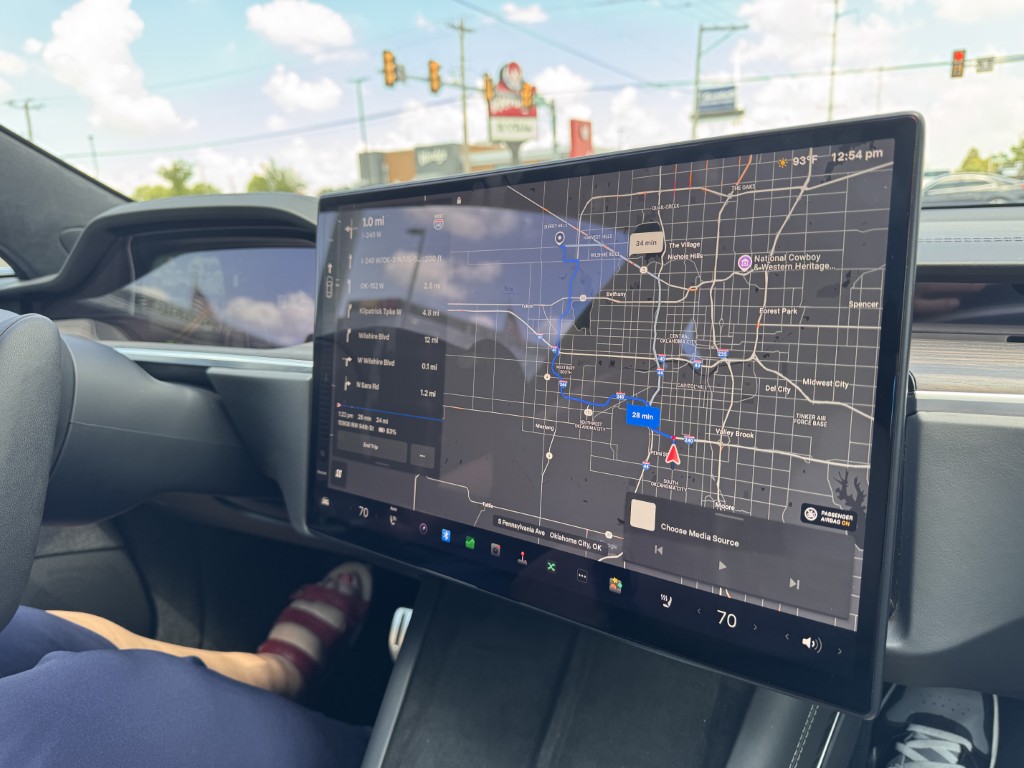
Before pulling out of the parking lot both Susan and I had to install the Tesla app on our phones. The app, in conjunction with your phone’s Bluetooth, becomes the car’s key. From outside, it’s how you pop the trunk and turn on the air conditioning to cool the car down before entering. The car monitors where you are based on the app. When approaching the car, door handles emerge from their flush-mounted hidey holes and the car unlocks itself. When you arrive at your destination and exit the car, there’s no need to lock the doors or even turn the car off. Simply walk away and the car realizes you no long want to play with it. The air conditioning turns off, the windows roll up, the door handles disappear, the alarm turns on, and half a dozen cameras monitor the vehicle, sending you video clips each time someone walks or parks a little to close to my precious.
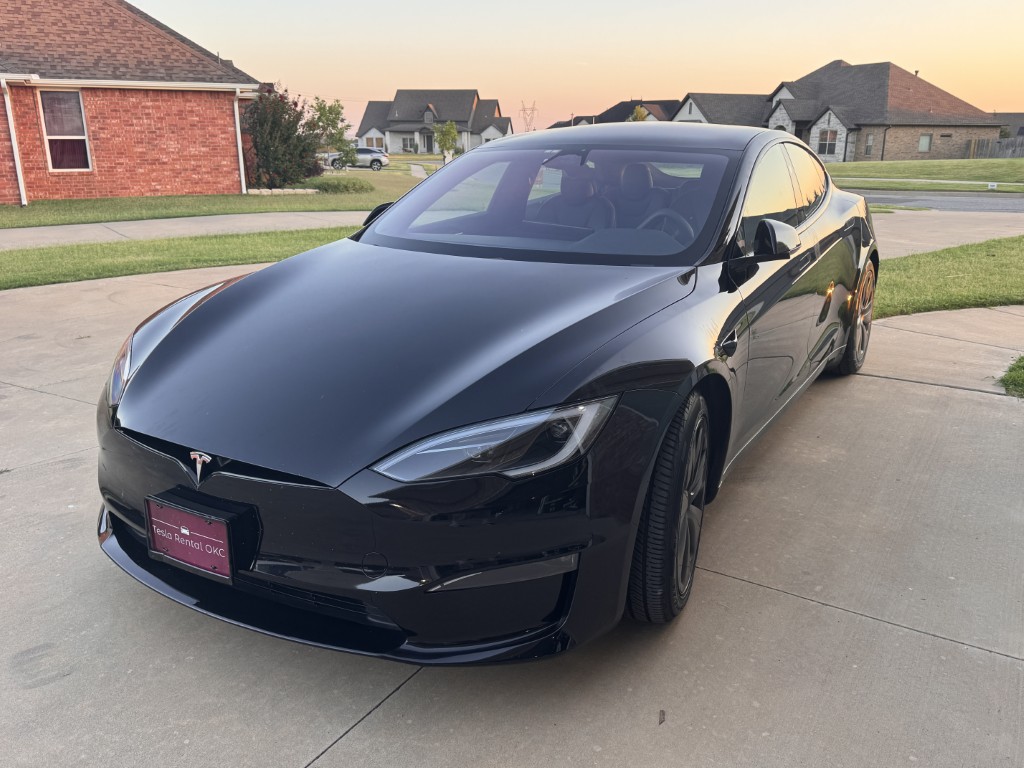
The Tesla S is available with one, two, or three electric motors, each one adding approximately 330hp to the vehicle. Ours was the two-motor version with all-wheel drive, which packs 670hp under the hood and an estimated 0-60 time of 3.1 seconds. The car weighs approximately 4,500 pounds with 1,200 of that being the batteries. According to Tesla the batteries should last between 300,000 and 500,000 miles, or approximately 1,500 charge cycles. Battery replacement costs $20,000+, so hopefully those lifespan estimates are correct.
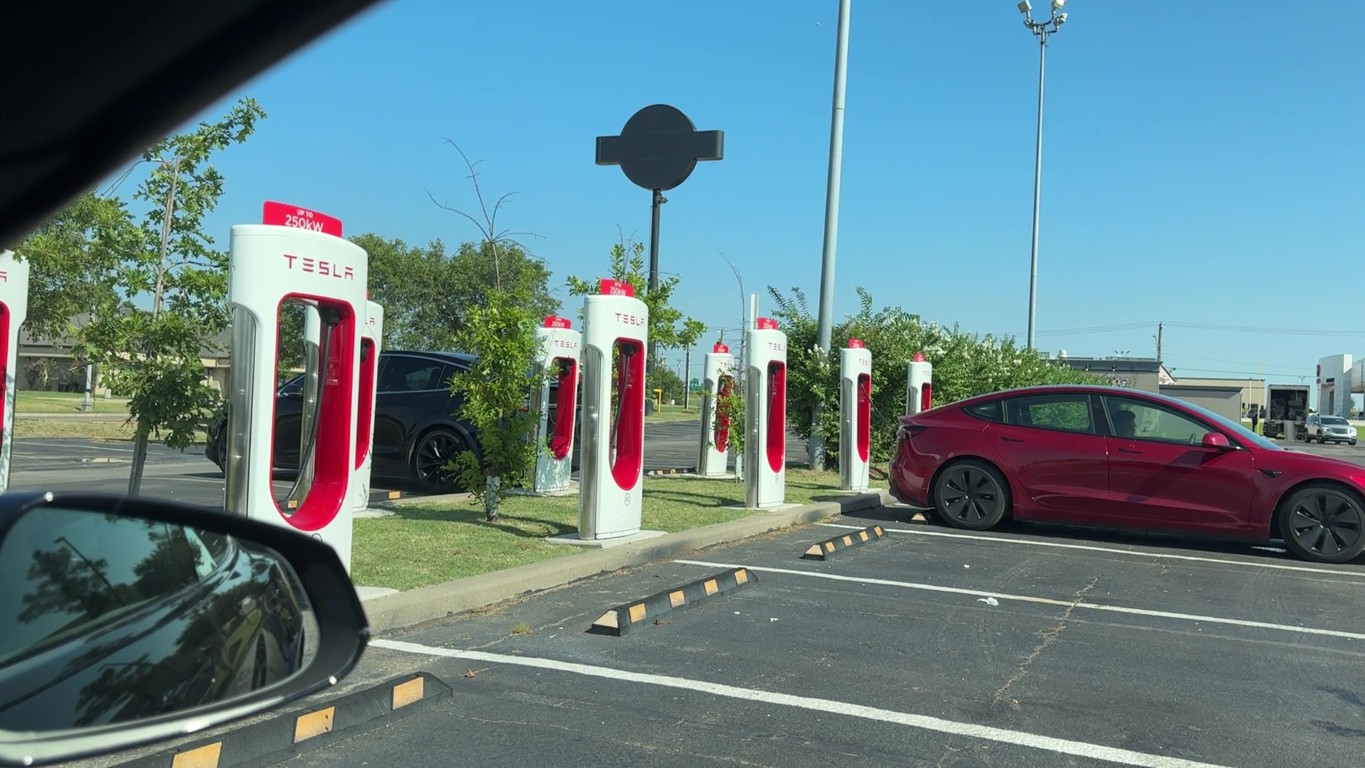
Welcome to a Tesla Supercharging station! Take a Tesla on a road trip like we did and you will become familiar with views like these. Tesla claims the Model S has a range of just over 400 miles on a full charge… but “full charge” implies a battery level of 100% and when charging the system recommends you stop at 80%. (Our app wouldn’t let us charge past 93%.) Real world estimates are closer to 350-370 miles per 100% charge, but again an 80% charge gives you 4/5 of that. Here’s the reality — in a car that claims a 410 mile range, we drove about 600 miles and charged four times.
Tesla Superchargers are pretty amazing, delivering power at a speed of 250kW/hour. Our car’s battery has a capacity of 100kW, but charging times are not linear. Charging the car from 40% to 80% took us about 10 minutes; charging from 80% to 100% was estimated at an additional 45 minutes. The idea is to never reach empty and never go to full.
While driving, Google Maps displays not only the route you’re on but the location of all known Tesla Superchargers. Punch a route into Google Maps and the car will tell you if it can make it there or not; if not, it’ll recommend an alternate route that hits a charging station. This is a great system until it fails. Susan had planned a route that the car told us would leave us with 10% battery life left, but after leaving it changed the number to -2%, which meant we had to alter our route.
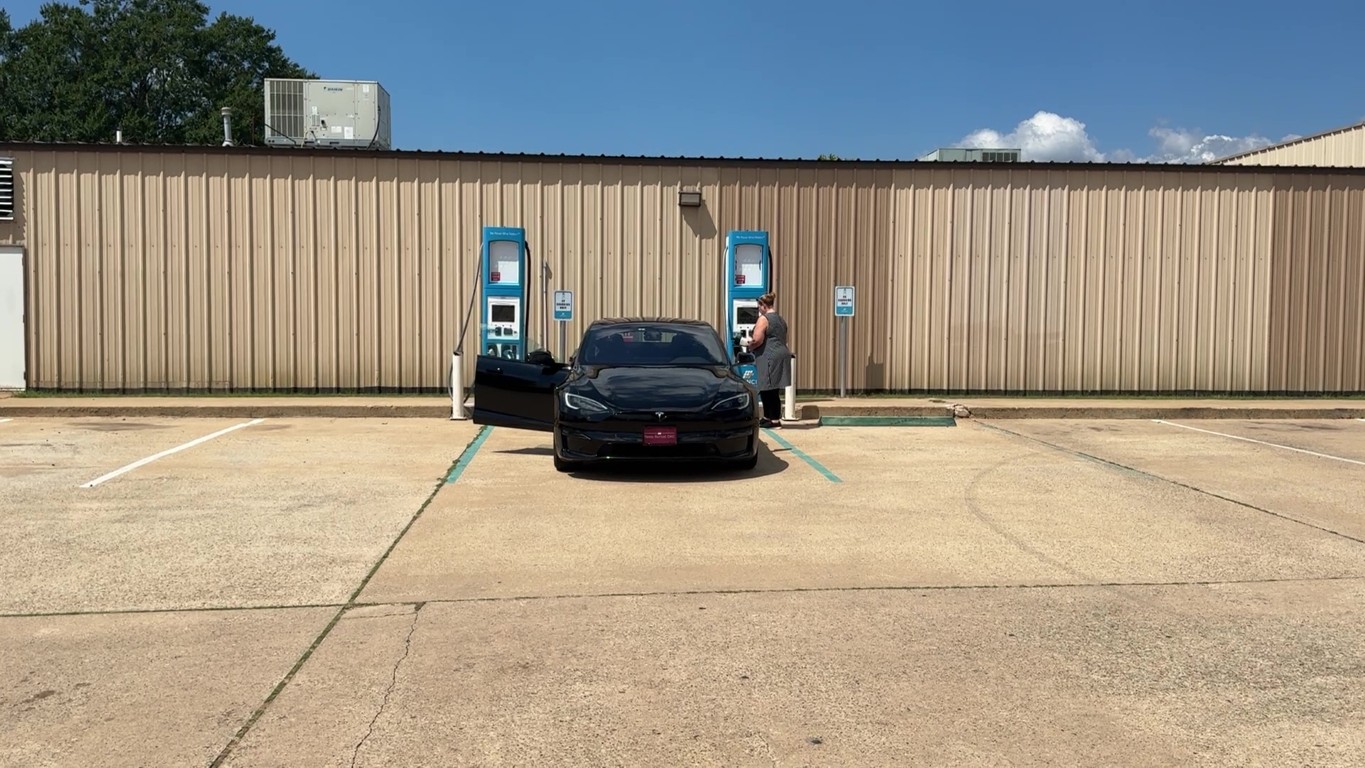
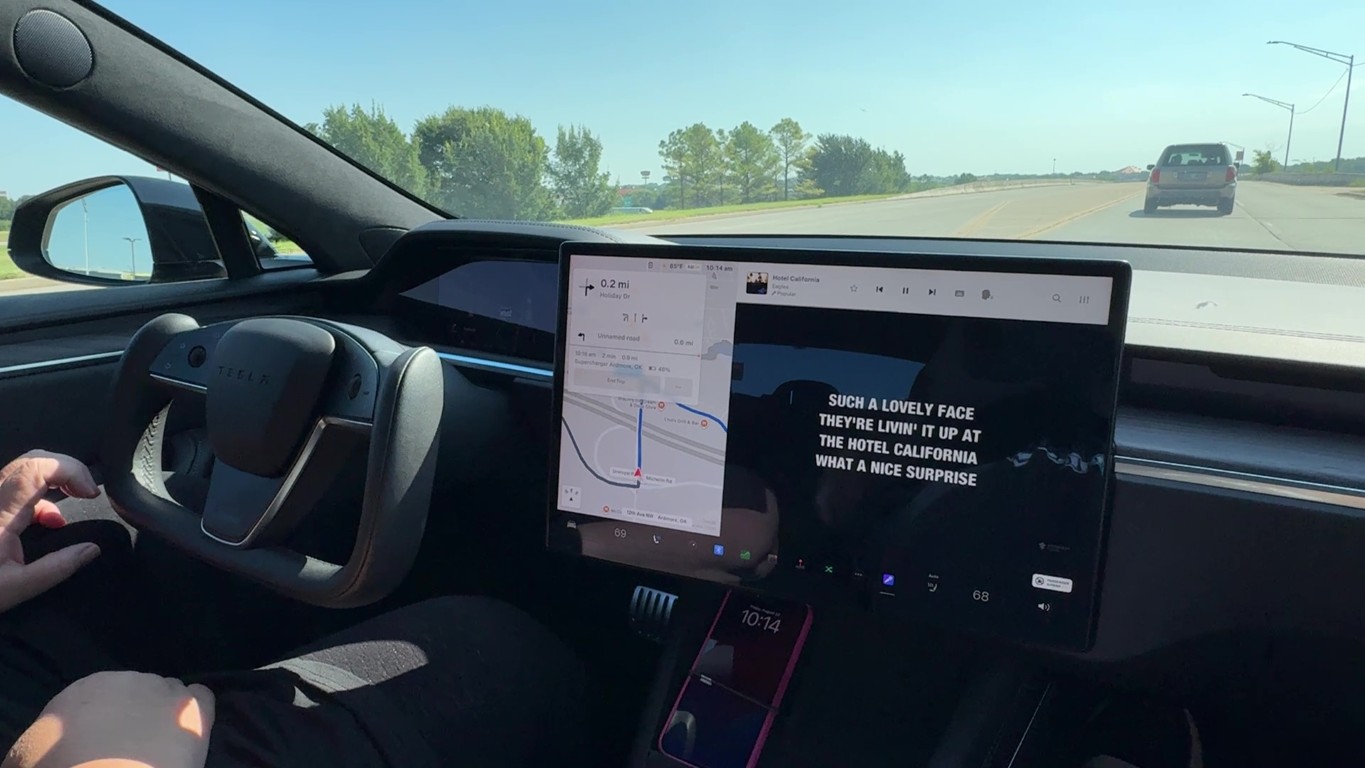
And that led us to Gardner’s Grocery in Antlers, Oklahoma, which has two Francis Energy chargers in their parking lot. Unlike a Tesla Supercharger, these chargers only put out around 100 kWh, or so they claim. Once connected to the Tesla with the help of an adapter, the car informed us it was charging at 35 kWh. In real world terms, that should have been adding 100 miles to the car per hour, but it wasn’t. After nearly an hour we had added approximately 60 miles to the car’s range. To put that in perspective, when compared to a traditional gasoline car that gets 20mpg, it took us an hour to pump three gallons of gas. I don’t know if the problem lied within these chargers or it had something to do with the adapter, but the reality was we had a long time to sing karaoke, one of the many applications built into the vehicle’s entertainment system.
Of course home charging is always an option, but to get any real world performance you would need to purchase a 220v Level 2 charger which costs around $500, needs to be installed by a licensed electrician, and could possibly require upgrades to your home breaker box or wiring. A Level 2 charger like this will gain you 25-45 miles per hour. A Level 1 charger, which plugs into any outlet in your home, will only deliver about 3-5 miles to the car per hour. Of course, none of that helps you during a road trip. You can either plan your trips around Tesla Superchargers, or plan to kill 45 minutes in a nearby Family General store and buy yourself a fancy Happy Birthday hat as your car slowly charges.
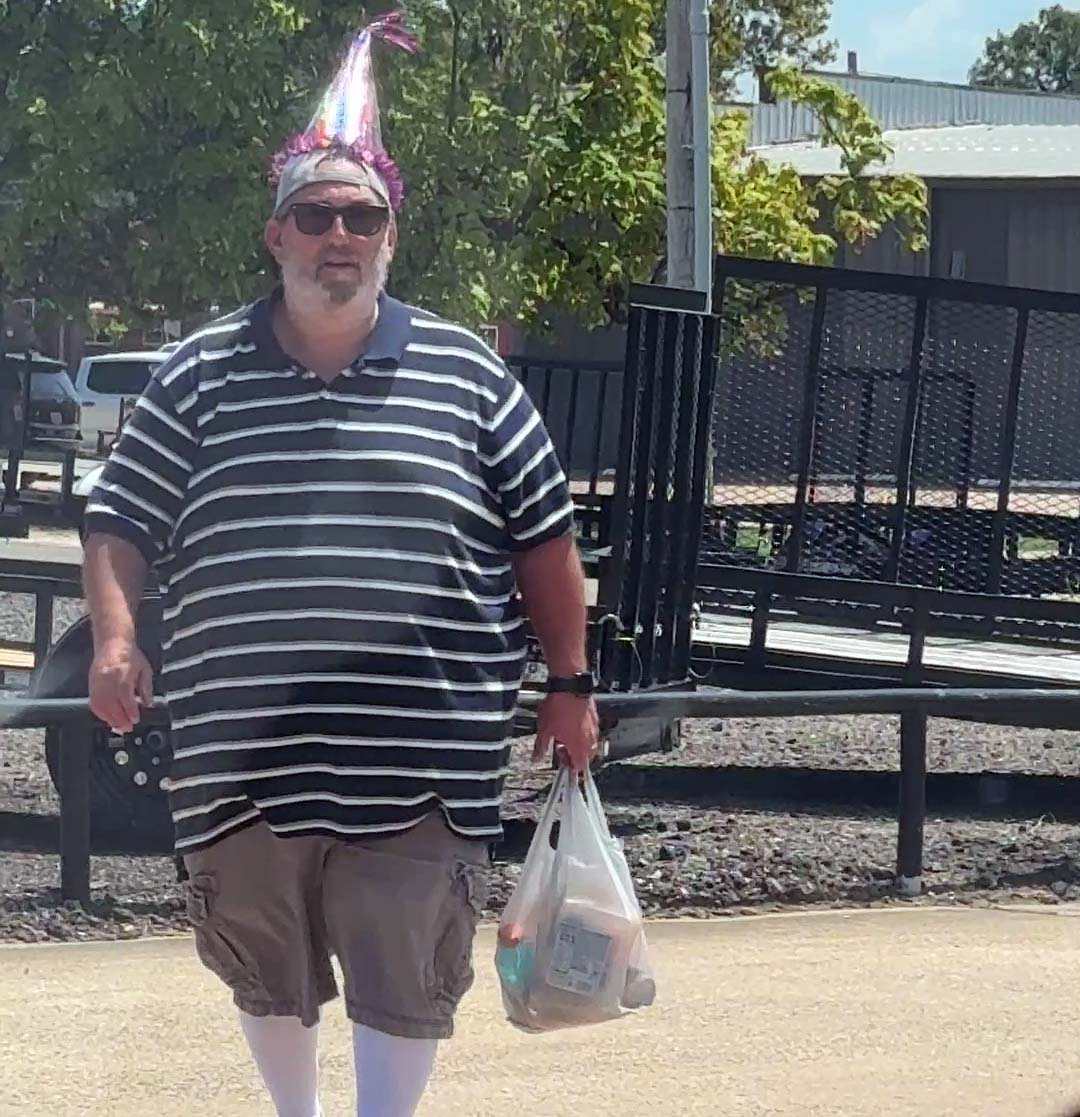
I gotta learn to stop wearing horizontal stripes.
So, let’s get into it. Let’s talk about Tesla’s fully self-driving (FSD) mode.
On all Tesla vehicles equipped with FSD, drivers (“drivers”) can punch an address into Google Maps on the touchscreen, press a button on the steering wheel to confirm… and off you go.
So many things to say about this. First of all, it’s a completely bizarre feeling — a combination of wonder and amazement and anxiety and terror all rolled into heart-pounding moment. It’s probably how Charlie Bucket felt when the Wonka-vator smashed through Willy Wonka’s glass ceiling, or possibly how Orville Wright felt during his first flight — except the Wright brothers’ first flight only went about 7 miles an hour. This car goes way, way faster.
In fact, you may notice in the above clip that the car immediately sped up to 80mph on the turnpike in a 70mph zone. One of the biggest problems we had with the car was its speed; not because it drives too slowly, but because it drives too fast. After a day’s worth of driving we discovered the “hurry” mode had been turned on (not by us) which tells the car to drive more aggressively, change lanes more often, and speed. (Other modes include “standard” and “chill”.)
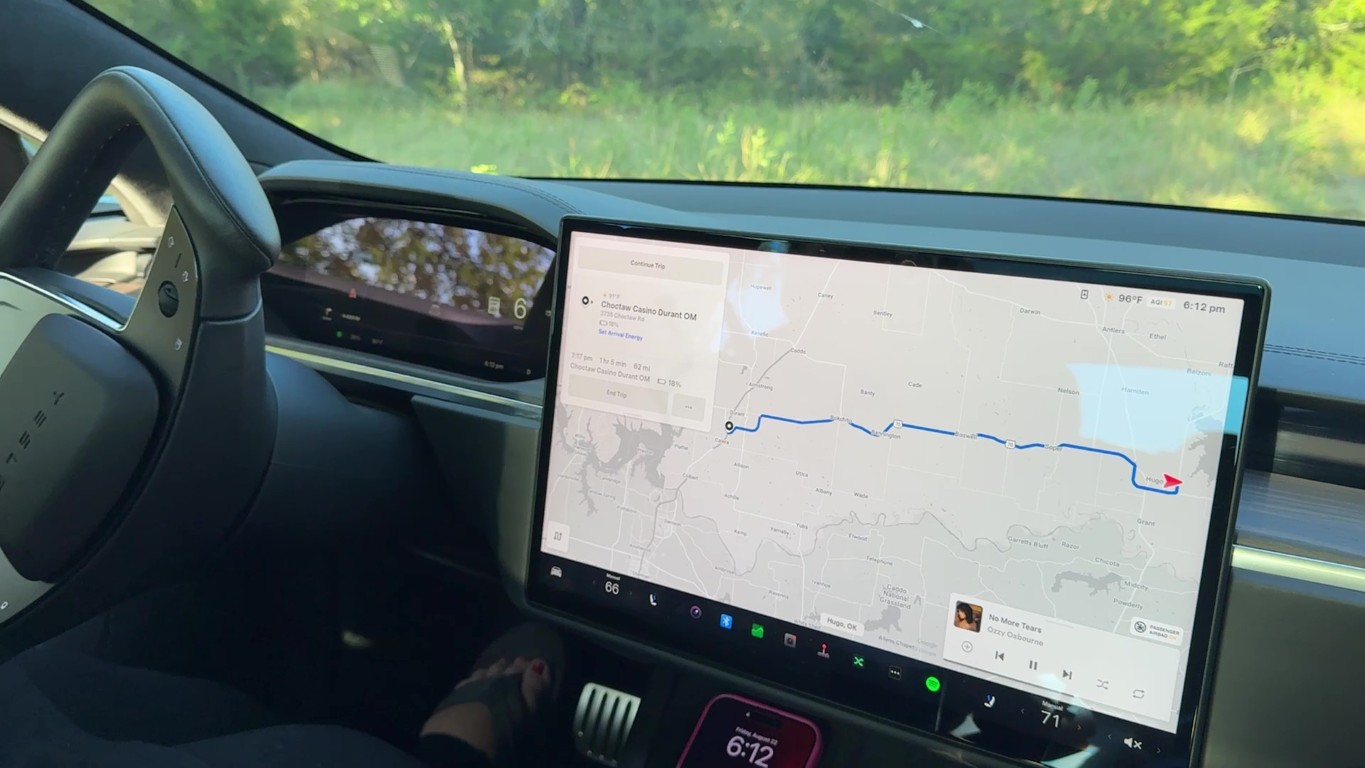
FSD redefines what it means to drive a car. In FSD mode, you are no longer driving, although you are technically the driver — or more importantly, the failover system. Any time the car gets confused or finds itself in a dangerous situation, FSD disengages and with the sound of an audible beep the driver is expected to take over immediately. And I mean immediately.
While it’s a little difficult to tell speed in the above clip, our car encountered stopped traffic on the interstate and at the last second and beeped to say, “take over.” Susan had to slam on the brakes (as in, tire skid) to avoid an accident which we would have received the ticket. This was not the only time this happened. One of Tesla’s biggest failures it being able to determine what the current speed limit is, or more specifically, when it drops. One day one the car sent me barrelling down Britton road at 45mph in a 35mph zone that and wasn’t slowing down as it approached an active school zone, putting me at 20mph over the posted limit and driving dangerously in a school zone. Not once did the car slow down as we entered a highway construction zone. It definitely slow-rolled a couple of stop signs while no one was looking, made a few questionable lane changes, and occasionally got confused when lanes merged.
And yet, the car can detect when a traffic light changes from red to green and gives you a gentle beep to let you know. It drove me from my dad’s house to my house, from my house to 7-Eleven, and from the rental location to our home completely hands free. Frankly, it drove 99.9% of the way from Oklahoma City to Dallas with no guidance. Tesla states drivers should keep their hands on the wheel and eyes on the road, and it’s for a good reason; not because the car needs you to most of the time, but because on the occasions it does, you’re about to have an accident. That turns the entire experience of driving from an interactive one to one in which you as the driver sit behind the wheel of a car driving itself, watching every second for an accident. FSD is not as relaxing as you might think.
So what’s the final verdict? It’s hard to say.
This car has a lot of quirks and is different from any other vehicle I’ve ever been inside. Relying completely on a giant touchscreen and a phone application to do literally everything from adjusting the radio to shifting the car into drive takes some getting used to. As someone who has worked in IT for decades I cannot help but worry about what would happen if Tesla’s servers went down or if the company went out of business entirely.
As far as the car itself goes, it’s fast and it’s an EV, which is better for the environment. (Even with the battery creation process and a higher emission cost up front, it is estimated that the break even point in regards to EVs and emissions is somewhere between 15,000 and 40,000 miles.) The seats aren’t particularly comfortable for long trips, but I don’t think that’s what this model was designed for. For committing, driving around in town, and even short trips, it’s pretty cool.
And then there’s the self-driving feature, which works great until it doesn’t. It’s so close to being there, but it’s not there yet. And maybe self driving never will be; maybe it’ll always be a thing that works 99% of the time and requires human interaction to save it from time to time. If every car on the road were self-driving and connected via some mesh network, every car would know what every other car is doing and things would be perfect. As stands, the Tesla is forced to react to other cars, pedestrians, road hazards, and a litany of other potential obstacles. All things considered, it’s amazing. But it’s not perfect.
As we rolled back into the rental location, Susan said she was a little sad to let go of the car and a little relieved. I agree. Tesla has so much going for it and as the technology continues to improve, it’ll only get better. This is definitely Future 1.0.
Discover more from RobOHara.com
Subscribe to get the latest posts sent to your email.