
A few years ago, Susan, the kids and I visited the Rock and Roll Museum in Cleveland. It was a super neat experience, and my only basis of comparison when Susan told us we were on our way to visit the Irish Rock and Roll Museum in Dublin.
After leaving the hotel on Drury Street, Susan noted there was an arcade along our path to the museum. It turned out to be George’s Street Arcade which, if you’re from the US, doesn’t mean “arcade” like “a place full of arcade games.” It was essemtially a blocks-long outdoor market in between two buildings. Apparently it is located in Dublin’s “Creative Corner” and the minute we cut through we saw a vinyl record store, botiques, and all kinds of cool shops (I believe there are about 40 or so). I would have loved to explore this area more, but our tickets to the museum were timed and so we had to move on.
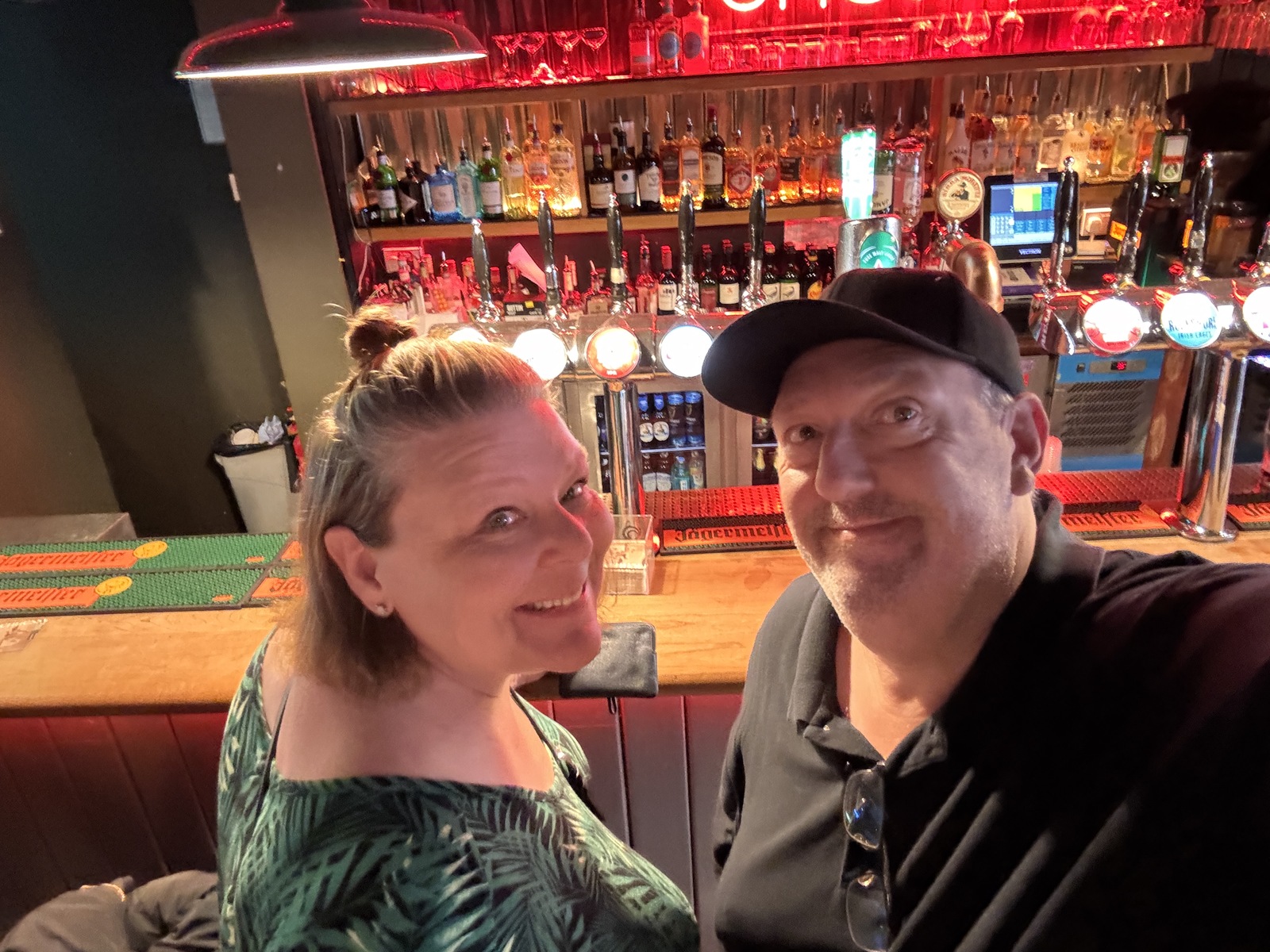
The Irish Rock and Roll Museum is located inside a working complex. There’s a working music studio and rehearsal space, a bar, a wax museum, and the museum. We only had a few minutes to kill and so we ended up hanging out in the bar, which was dark and dirty and felt like a place rock and roll bands might hang out. While waiting I checked out the National Was Museum on my phone and we decided to skip it and just stick with visiting the Rock and Roll museum. I will say that unlike most wax museums I’ve seen, it appears you can pose with and literally touch the figures which is weird. (A href=”https://youtu.be/m2GNykjiAs4″ target=”_blank”>YouTube Link)
Prior to entering the Rock and Roll Museum, Susan and I tried to brainstorm famous Irish bands. U2 is the obvious one, and while we were waiting in the lobby a video display started playing a live performance from Sinead O’Connor, which is another obvious one. Other than that, we struggled to come up with what all we would find inside the museum.

The Irish Rock and Roll Museum is, more or less, divided into four major areas. The first area is dedicated to Rory Gallagher. If you are not from Ireland and not into semi-obscure rock music from the 70s then there’s a good chance you have no idea who Rory Gallagher was. In fact in our group of 12 people, only I and the two people from Dublin had heard of him, and I couldn’t name a single one of his songs.
Each room and featured artist was specifically chosen, and Rory Gallagher was cited as the artist who brought rock and roll to Ireland. Gallagher was a madman on the guitar but better at playing music than marketing it. He apparently refused to release radio singles and despite being “a guitarist’s guitarist,” is not well known outside of Ireland.
Also, our tour guide cited a famous quote from Jimi Hendrix. When Hendrix was asked “How does it feel to be the greatest guitarist in the world?” he reportedly replied, “I don’t know, ask Rory Gallagher.” I tried to find where the quote came from and apparently… it’s an urban legend. There’s no record that Hendrix ever said that. One thing this trip reenforced was that the Irish never let the facts get in the way of a good story.

Next up was the U2 room, featuring instruments, records, and other paraphanelia belonging to the band. U2’s place in the museum is obvious and undeniable as they are the most successful band to come out of Ireland with record sales of more than 150 million.

The third room was dedicated to Thin Lizzy, which was framed as Ireland’s first internationally successfull rock band. For the record, I was able to name three Thin Lizzy songs from memory (“The Boys Are Back in Town”, “Jailbreak”, and “Dancing in the Moonlight”) and was reminded of a fourth, “Whiskey in the Jar”. The museum had a LOT of Thin Lizzy memorabilia, from instruments and flyers to the jukebox that resided in Phil Lynott’s mother’s home. Apparently he filled it with Thin Lizzy records so that she could listen to him while he was away on tour.
The elephant/mixing board in the middle of the room is a Neve brand mixing and recording console. Our tour guide told us about the Neve 8028, a ramous mixing board of which only five were made and only two are known to exist. Famous albums recorded on the Neve 8028 include Nirvana’s “Nevermind”, Fleetwood Mac’s self-titled album, Tom Petty’s “Damn the Torpedoes”, Rage Against the Machine’s debut album, and Rick Springfield’s “Working Class Dog”, among countless others. David Grohl’s 2013 documentary Sound City is about the Neve 8028 that he purchased from Sound City Studio when it closed down.
I would swear to you our tour guide said this was one of those consoles. Google says it’s a Neve 8078, which is no less rare (it’s apparently one of four), but it’s not the same model. Lots of albums were recorded on Neve consoles, but none that I can find on this model. Again, never let the truth get in the way of a good story.

The final room, which literally existed in a stairwell, I would title “every other notable Irish band or performer. This is where the Cranberries and Sinead O’Connor were mentioned along with the Pogues, Boomtown Rats, and a few others. There was also a synthesizer used on Michael Jackson’s final album (which was recorded in Ireland) and a pair of his pajamas and a story about his final days recording there which I 100% believed until finding out many of the other stories may have been fudged a bit. :)
Like several of the tours and museums we attended, the charm of Ireland’s Rock and Roll Museum isn’t isn’t necessarily in the guitars or flyers on display, it’s in the stories. Our tour guide (Matthew) did an excellent job of sharing Ireland’s rock history (and plugging his fiance’s band Fionn, which you can see here covering a System of a Down song on the fly).
While the Irish Rock and Roll Museum would probably fit inside the lobby of the Rock and Roll Museum in Cleveland, it was full of charm and stories and we definitely enjoyed our time there.
Link: Irish Rock and Roll Museum
Discover more from RobOHara.com
Subscribe to get the latest posts sent to your email.