
Surprise! One year ago today, I purchased a 2026 Tesla Model Y. If you didn’t know that, you’re not alone. All of my friends and family knew, but I haven’t going out of my way to publicly mention it. Today, on “Yoshi’s” first birthday, I wanted to talk about why I bought a Tesla and what it’s been like to own and drive it.
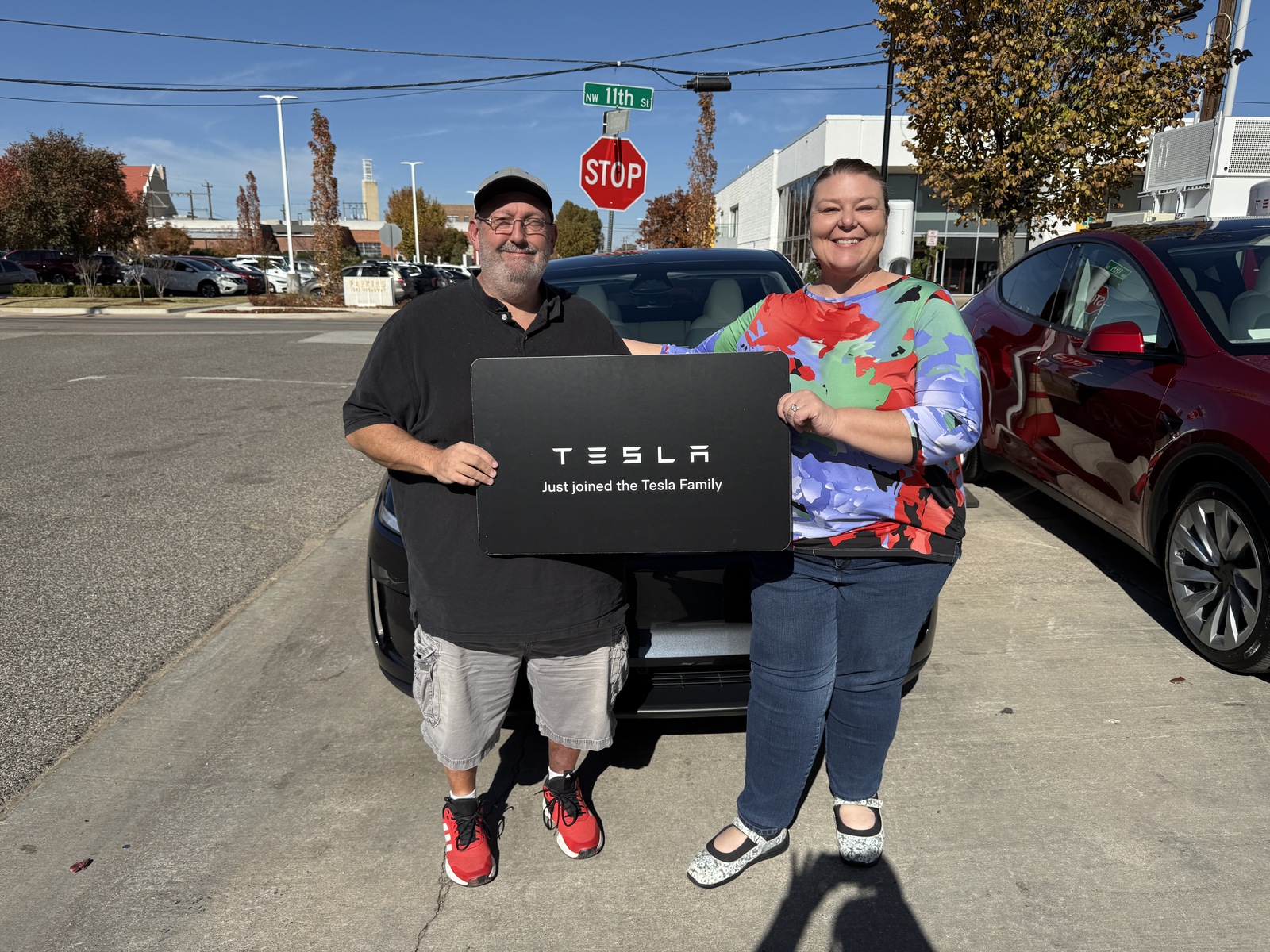
The primary reason I haven’t mentioned the purchase before now is that I can’t think of a company more divisive than Tesla. People have lots of opinions about not just Tesla but Elon Musk. I’ve had complete strangers approach me in parking lots to tell me what they think about Musk, the car, or EVs in general. As one friend put it to me: “Democrats hate your car because of Musk, and Republicans hate your car because it’s electric.” I tend to avoid conflict and didn’t purchase the car because I wanted to debate or defend the company. In fact, none of those things had any influence on my decision to purchase the car and as I often tell people, I bought the car despite Musk, not because of him.
As a fan of technology I’ve been fascinated by Tesla’s cars for years, but it wasn’t until my vision began to diminish that I began seriously looking into purchasing one. The worse my vision gets the more difficult it has become for me to follow traffic rules, especially in areas I am unfamiliar with. According to the state of Oklahoma my vision is still good enough to drive but I am feeling less and less comfortable doing so. When I discovered Tesla’s self-driving abilities, I began to look into them. For my birthday in 2025 Susan and I rented a Tesla and took it on a mini road trip. Based on that experience, we began discussing the idea of purchasing one.
Before purchasing my Tesla I drove two other cars that claimed to have self-driving features, one Ford and one Cadillac. For cars available at this time in America, no other car remotely comes close to the Tesla in terms of self-driving. Every other company’s self-driving features only work on interstates (not on city streets) and will perform speed matching and lane changes but not much more. The Tesla will take you from your starting point to your destination without ever touching the steering wheel or pedals. On a scale of 1-10, the other cars I tested were a 4 and the Tesla is a 3,000. If you want this level of self-driving and automation, there is only one choice.
In a moment of full disclosure I’ll tell you that with the long-range battery option and upgraded white leather interior, my Tesla 2026 Model Y cost roughly $42,000. Susan selflessly traded in her Cadillac and adopted my Ford Flex as her daily driver. This week it was reported that the average price of a new car in the US is $51,000 which puts the Tesla below average. Tesla currently sells four models (S,3,X,Y — and yeah, that’s childish) and up until last week, the Cybertruck. Two models (the 3 and the Y) are in the $30k-$40k range and the others are all near or over $100k. People assume a lot of things about Tesla owners, one is that they are rich. I am not.
Tesla’s Full Self-Driving (FSD) requires a human being to be behind the steering wheel and conscious, but not much more. Legally, the person in that seat is still the driver and it is up to that person to take action to prevent an accident. The reality is, the Tesla can acquire and process input faster than any human. Each of the 8 external cameras capture data at 36 frames per second — that’s 8 pictures every 0.0278 seconds. Each of those pictures are being analyzed multiple times in real time. It is not humanly possible to react faster than this car. I have taken control of the car many, many times — it tends to park in weird parking spots and sometimes picks odd routes, but not once have I ever had to take over for safety reasons. Never, not once.
I want to describe how the self-driving system works. Drivers can use the car’s touchscreen or the microphone and select a destination, at which point the car asks you to verify the destination by pressing a button on the screen or steering wheel… and off you go. The car also has Grok (AI) built in, so you can say things like “tell me the three closest breakfast diners” or “what’s the closest Chinese restaurant with a four-star rating on Yelp” or literally anything you can think of and it’ll give you options. Under normal conditions the car does not require drivers to touch the steering wheel or pedals, but there is an inward-facing camera that ensures the driver’s eyes are focused on the road. Depending on driving conditions, the camera checks once between every 30 seconds and every 3 minutes. Frankly, I think this is for legal reasons. The car does not need any input from drivers.
This allows you to do dumb things like tell the car to take you to a McDonald’s 100 miles away just to buy one McChicken sandwich and two drinks.
There’s more to the car than the self-driving, but since I use it so often let me summarize what it can do. It reads speed limit signs and adjusts your speed accordingly. It follows traffic lights, stop signs, school zones, and even hand signals from traffic cops. It stops at crosswalks if people are present and can handle drive-thrus. It has adjustable modes that range from “Sloth” to “Mad Max” that control things like acceleration rate and lane changing. It monitors traffic and adjusts routes based on traffic jams you are miles away from. Again, the system is not perfect. It often chooses the shortest route even if we would not consider it to be the “best” route. It’s also not always (for lack of a better word) courteous. Especially on the more aggressive driving modes the car will occasionally cut off other drivers or wait until the last moment to change lanes. The car is always safe, but it’s not always polite.
For two decades we’ve been telling drivers to put down their electronics and focus on the road. Driving a Tesla is a lot like operating an iPad in a moving vehicle. Except for a few minor exceptions (notable the blinkers and the power windows) everything is done through the touchscreen menu. There are no dials or gauges on the dash, no gear shift, no way to open the glovebox or adjust the windows. I often describe the car as being “minimalist to a fault.” The good news is, there are two other ways to control the vehicle. The first is with your voice. There’s a microphone button on the steering wheel. Press it and you can issue almost any comment verbally, whether it’s “fold mirrors” or “turn on driver’s seat warmer” or “set temperature to 70”. All the navigation options can be done verbally, too. “Take me to 7-Eleven” will open the map and present you with a list of nearby options along with showing them on a map. There are also a couple of buttons on the steering wheel but more importantly, two small clickable dials. The one on the right affects driving and allows you to easily change the speed and driving modes, and the one on the left is normally used to manage the radio but can be used in other menus.
That being said, the actual touchscreen menu can be confusing. It involves pressing precise buttons on a moving touchscreen. Some options are difficult to find, although again most of them can be accessed via voice. Other than light and dark modes, there isn’t any way to adjust the look and feel of the menu — no changing of colors, zooming in, or anything like that.
Some of the car’s functions can also be controlled through the Tesla app on my phone, which also serves as the car’s key. With the app I can pop the trunk (and the “frunk”), turn on the car’s heater or air conditioner, view the cameras remotely in real time, monitor charging, and several other things.
Through the app you can also “summon” the car. After emerging from a store, I can hold down the “come to me” button and this car will drive itself from wherever I parked it and come to the front of the store and pick me up. While it’s driving you can see a map of where the car is as well as look through the cameras. While driving itself the car is limited to a top speed of 8 mph. It automatically stops anytime it sees a pedestrian or moving car, only works as long as you are physically holding down the button on your phone, and only works in parking lots and doesn’t work on public roads. It doesn’t work in every parking lot, it has failed to pick me up more than once, and Susan is especially terrified of it running over someone. After a few times you start to get the feel where it’ll work and where it won’t. Whether it’s at the casino or a restaurant, people’s jaws drop when they see a driverless car pull up and watch people get in. It never gets old. When it works, it’s like watching something from the future. But like I said, it took us a few tries to get it right.
As I previously mentioned, the fact that the Tesla is an EV was not a part of my decision. I believe all self-driving cars are either fully electric or hybrids, so going electric comes with the territory. This is the first EV I’ve ever owned (and except for the one we rented, ever driven). As someone new to electric vehicles, I had three concerns: what was the car’s range on a full charge, how often would I have to charge and how long does it take, and how much was this going to save (or cost) me.
I purchased a Tesla with the long-range battery, giving me an estimated range of 360 miles. You’ll never get that, by the way. There are so many variables, from the outdoor temperature to how fast you accelerate, that you might get 320-330 miles if you drove the car from 100% down to 0%. For easy math, I usually just assume 300 miles on a full charge — or 3 miles for every 1% of the battery. I’d rather guesstimate low than high. One of the first things I learned is that Tesla (and all EV companies) suggest charging the battery up to 80% and recharging when you reach 20%. That means the recommended “usage” area is 60%, which if “1% = 3 miles”, now you’re looking at 180 miles. You can certainly charge the battery up above 80% and drive it below 20% on road trips or at your own discretion, but that sweet spot of 20%-80% provides the fastest charging and best lifespan for the batteries.
There are three levels of chargers (Level 1, 2, and 3). Level 1 chargers plug into any wall outlet, just like the ones in your house. With one of those you’ll gain about 1% (or 3 miles of range) per hour. I used this exactly one time, just to see how it worked. A week before purchasing the car, I had a Tesla charger installed in my garage (thanks, Taylor!). The price of the charger was around $500, plus installation. With this, I can charge my car from 20%-80% in about 4 1/2 hours. Having a charger at home makes it almost feel like I’m driving the car for free. Once or twice a week I plug the car in when I get home and when I leave, I unplug it. (You can control charging limits and times through the app.) Those giant red Tesla chargers you have seen around town are Level 3 chargers. One of those can charge the car from 20%-80% in about 25 minutes.
So how much does all this charging cost? At home, I pay $0.12 cents per kilowatt (kW). If you do the math, it costs me about $5.40 to charge from 20%-80%. It’s a little difficult to do an apples-to-apples comparison, so let’s do it this way. With that amount of battery we’ve determined I can drive 180 miles, so in the Tesla 180 miles = $5.40. On the other hand, my Ford Flex gets around 15/mpg so assuming a gas price of $3.50/gallon (I did the math — Mr. Shultz, I did it!) it costs $42 to drive 180 miles. Simply put, the Tesla is 8x-9x cheaper to drive. Those numbers assume the car is being charged at home; those chargers in parking lots are often 2x-3x higher than what I pay at home, but 3 x $5.40 is still a lot cheaper than $42.
A few casinos have started adding free Level 2 chargers, including the Lucky Star Casino in Geary and the Choctaw Casino & Resort in Hochatown. And by “free” I mean we always end up inside the casino and the “free charging” can get expensive in a hurry.
For normal day-to-day driving, I spend less time charging my car than people spend putting gas in theirs. The exception to this is when taking the car on road trips. We’ve driven the Tesla to Texas a few times and once 1,000 miles to West Virginia. It takes 25 minutes to recharge the Tesla and so if you are in a hurry and trying to fill up and move on, yes, it takes longer. For Susan and myself, we stop about every two hours to stretch, get a drink, and use the bathroom. On our last trip to Texas, after hooking up to a charger at Buc-ee’s we went inside, used the bathroom, walked around, bought pulled pork sandwiches, and by the time we made our way through the crowds and parking lot and returned to the car, it was done charging. All I can say is, before purchasing the car it was one of my top concerns and today it is such a non-issue that ultimately saves me time and money.
If sitting inside a car waiting for it to charge sounds boring, please know that the car has Netflix, YouTube, and a web browser built in to that giant touchscreen. It has roughly 20 built-in games which are fun and support a Bluetooth gamepad. There’s a built-in photo booth for taking selfies, a “romantic mode” that plays video of a fireplace while turning on the car’s heater, and “car”aoke, which supports Bluetooth microphones. All of these entertainment options are only available when the car is in park and more than once Susan has had to wait for me to finish the game I’m playing before we can start driving. There’s a second, smaller screen in the back for passengers that can be used when the car is moving.
All of this technology comes at a price, and that’s privacy. At a minimum, Tesla knows when you drive, where you drive, where you go, and how long you stay there. (Then again, so does your phone…) The car has 8 external cameras and one inside that are always recording (even when you’re not in the car) and you have to think those can be viewed remotely. Using Grok AI to control the car is amazing, but no doubt that’s being tracked somewhere, too. There’s a microphone in the car and they say it’s not being monitored or recorded, which is what every company says until they get caught doing so. Most of the apps we use on our phones track our usage and sell our data, but this is exposing a lot of information to one single company. This is not the car for spies or bank robbers, I’m afraid.
As a guy who grew up with and still enjoys technology, it’s hard to see the Tesla as anything but a big rolling computer — a fact I’m reminded of roughly once a month after the car receives an update and has to reboot. The battery is projected to last 300k-500k miles, but it is not lost on me that when the battery no longer works or if Tesla goes out of business, I own a $40k brick. I’ve read that the creation and destruction of these large batteries is just as bad for the environment as traditional gasoline and diesel engines. I struggle with putting money in Elon Musk’s pocket.
Also, and this may sound weird, but after a while sitting in a self-driving car is kind of… boring. For the first month I was terrified and for a while after that it’s a neat novelty, but once the excitement wears off there’s just not that much to do. It’s like riding a bus but having to look forward every minute or two. On a recent drive to Ardmore, the only problem I encountered was struggling to stay awake. If you’re a car person who loves shifting gears and the rumble of a finely tuned exhaust, this might not be for you. (To be fair, the car does 0-60mph in just over 3 seconds.)
But would I buy it again? You bet I would, in a heartbeat. The car’s self-driving features are not only neat, but allow me to drive more safely. The law in Oklahoma states that if your vision falls below a certain level you can no longer drive and I may not be able to operate this car forever, but for as long as I can, I will. I can no longer drive at night, but the Tesla has no problem taking me somewhere at midnight. If and when other companies begin to release self-driving cars I will consider them, but for right now this is what we got, and this is what I drive.
Happy birthday, “Yoshi”. We had fun the first 12,800 miles and I’m looking forward to driving riding many more!
PS: None of this would have been possible without Susan. She was the one who rented a Tesla in the first place, suggested I buy one, and traded in her own car toward this one so we could purchase it.
PPS: Because it’s a Model Y, I decided the car’s name should begin with the letter Y. It was briefly named Yori (a TRON reference) before settling on Yoshi, a videogame reference and nod to my old friend Josh, who would have loved this car.
Discover more from RobOHara.com
Subscribe to get the latest posts sent to your email.