
It’s been nearly 20 years since I released the original version of eCoder Ring. This year for Thanksgiving I decided to give the original a facelift, update the code, add a few new features, and re-release it.
eCoder Ring is simple to use. After adding your own key file, type a message into the deCoded box and then eCode it. The code consists of numbers representing the location of each letter in the key file. To deCode a message, paste the numbers into the eCoded box, load the same key file that was used to eCode the message, and click deCode. Simple!
Download Link: https://archive.org/download/official_unsolved_mysteries_podcast_archive/eCoder%20Ring%202.0.zip
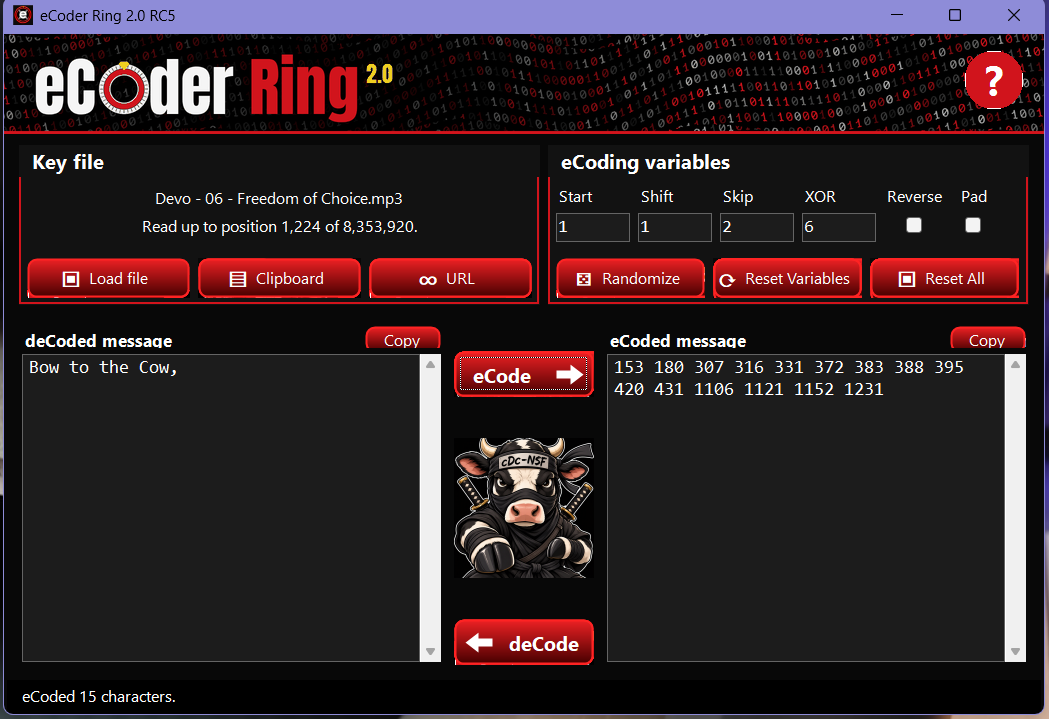
Not only can you use text files as key files, but pretty much anything including pictures and executables. eCoder Ring loads the file and converts it to ASCII, so a JPG or PNG file is simply converted into a long list of random numbers and letters that can be used to eCode a message. You can even point to a picture, file, or book that’s stored online. As long as the recipient has the same key file, the message can be deCoded.
I included the original four modifiers (Start, Shift, Skip, and XOR) and added two new ones, Reverse and Pad. These are all explained in detail in the app’s help file, but essentially what they do is modify the coded numbers to further obfuscate the real code. For example, a Shift value of 2 adds 2 to every number. Again, the person deCoding the message has to have the same variable settings, otherwise all the numbers will be off by 2 and the message will appear as random garbage. The new Reverse feature reads key files in reverse order from back to front, and Pad adds characters to the end of a coded message to hide its true length. Even if someone intercepted your secret code and knew the key file, they would also need to have the same variables, which add millions of random combinations.
eCoder Ring is for entertainment purposes only. Because it is based on a traditional book cipher, the only real way to break a code is to have the key file and variable settings. A brute force attack involves throwing random key files into the program and trying random variables. On the internet alone there are billions and billions of files that can be used as key files, with millions of variable variations. I asked AI to try and deCode a message using brute force and after a few minutes it estimated it would take “longer than the existence of human civilization” to break.
That being said, the weakest link in a cipher such as this is that both people must know and keep secret the key file and the variable settings. The easiest way to obtain the key file would be to hack someone’s computer, sniff their network traffic, obtain it through social engineering, blackmail them, or threaten them with physical harm. As I said with the original, eCoded messages can withstand centuries of brute force attacks, but will fail pretty quickly if you’re being waterboarded. So there’s that. Realistically if key files and variables are exchanged offline and kept private, eCoded messages are essentially unbreakable — that being said, eCoder Ring is not a substitute for true, peer-tested encrypted methods. Use it for fun, not guarding state secrets.
Download Link: https://archive.org/download/official_unsolved_mysteries_podcast_archive/eCoder%20Ring%202.0.zip

Discover more from RobOHara.com
Subscribe to get the latest posts sent to your email.